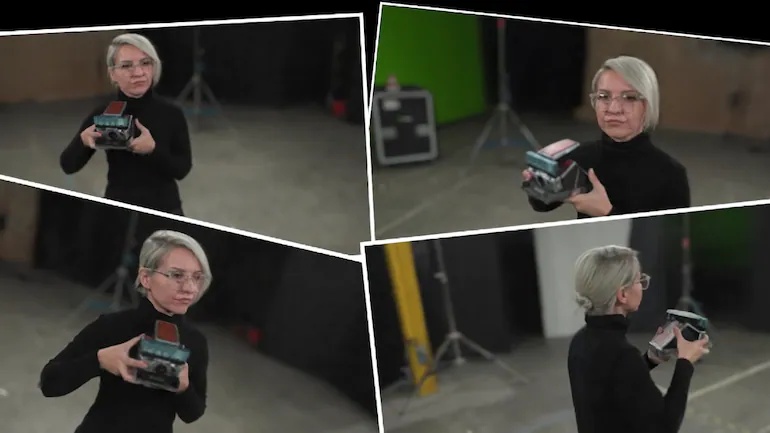
We can capture moments in the world around us in the form of photographs thanks to the technology we use in our daily lives. However, the method can only produce a 2D representation of the 3D world we observe. Scientists have been attempting to generate 3D instances from these 2D images, and Nvidia may have developed game-changing technology in this regard.
The new capability, dubbed Instant NeRF, was unveiled at Nvidia GTC, a global conference for AI developers. The technology is a step forward from NeRF, or neural radiance field, which is used to create realistic 3D sceneries from a set of 2D photos.
Inverse rendering, which uses artificial intelligence to estimate how light will act on or around an object in the real world, is utilised for this.
According to Nvidia, its research group has developed a faster version of NeRF. Nvidia claims that its new technology “accomplishes this task [inverse rendering] almost instantly,” according to a blog post on the work. As a result, the title “Instant NeRF” was chosen.
With this, Nvidia says that its technology is “one of the first models of its kind to combine ultra-fast neural network training and rapid rendering.” As mentioned in its blog, Instant NeRF is able to learn a high-resolution 3D scene in seconds, and “can render images of that scene in a few milliseconds.” This is touted to be “more than 1,000x speedups” than regular NeRF processes seen to date.
Nvidia says, the AI model only needs seconds to train on still photographs before it can produce a 3D depiction. It does so by using “a few dozen still images” of the object, as well as information on the camera angles from which the shots were obtained. Instant NeRF can then render a 3D scene based on the 2D photographs in “tens of milliseconds.”
The technology appears to be amazing right away. Nvidia is well aware of this, and has not shied away from emphasising it throughout the presentation and in the blog. “Instant NeRF could be as significant to 3D as digital cameras and JPEG compression have been to 2D photography,” says David Luebke, vice president of graphics research at NVIDIA.
The Nvidia CUDA Toolkit and the Tiny CUDA Neural Networks package were used to create Instant NeRF. The company says that this is a lightweight neural network that can be run on a single Nvidia GPU, with the best compatibility on Nvidia Tensor Core cards.
In terms of potential applications, Nvidia claims that Instant NeRF will make it easier to “teach robots and self-driving automobiles” to precisely assess real-world objects using simple, 2D images. It can also make it easier to generate digital representations of real-world surroundings than current technologies. With the metaverse and other immersive technologies gaining acceptance at a rapid pace, Nvidia may have created an extraordinarily useful tool at just the right time.