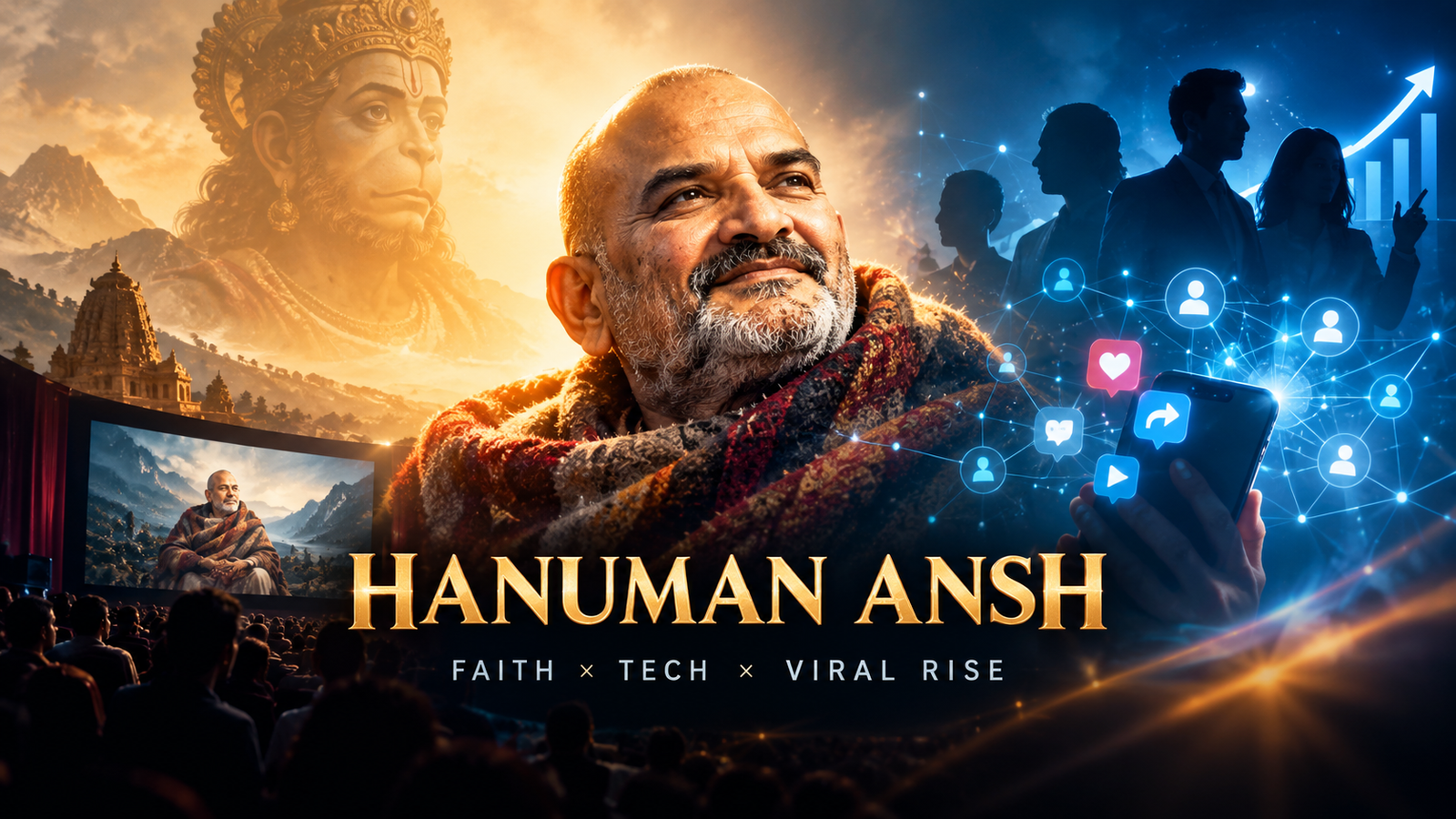
Mumbai I 06 Sep 2026: In an era when big-budget films increasingly depend on superstar casting, massive advertising campaigns and algorithm-driven promotional strategies, Hanuman Ansh is emerging as an unexpected case study in how a story can travel through audiences organically—and how technology can amplify cultural and spiritual narratives in ways traditional marketing cannot always predict.
Based on the life and teachings of Neem Karoli Baba, the Vishal Chaturvedi-directed film initially opened with relatively modest expectations. Yet its trajectory changed dramatically as audiences began discovering and recommending it through social platforms and word-of-mouth. Reports now place the film’s box-office performance at several dozen times its reported production budget, making it one of 2026’s most striking low-budget success stories.
The phenomenon becomes even more interesting when viewed through a technology lens.
From Traditional Marketing to Community-Led Discovery
The old model of cinema promotion was relatively straightforward:
Studio → Advertising → Celebrity → Audience
The emerging model looks very different:
Content → Early Audience → Social Sharing → Communities → Influencers/Celebrities → Mass Adoption
Hanuman Ansh appears to be benefiting from the second model.
The film’s initial theatrical journey was reportedly slow, but audience interest subsequently accelerated. Its performance became a topic of conversation across social media, entertainment platforms and personal recommendations. Indian media reports have described the movie as a “sleeper hit,” while filmmaker Anubhav Sinha recently argued that its success, alongside that of Mirzapur The Movie, reflects a broader change in audience behaviour rather than a random box-office accident.
This is precisely where technology becomes relevant.
The Algorithm Is No Longer the Only Gatekeeper
Streaming platforms and social networks have trained audiences to discover content through recommendation engines. But Hanuman Ansh demonstrates another important phenomenon: human recommendation can become an algorithmic signal.
One person’s reaction becomes a WhatsApp message.
A WhatsApp recommendation becomes an Instagram post.
An Instagram post becomes a Reel or short video.
That content generates comments and shares.
The resulting engagement creates more visibility.
The cycle then feeds back into search, ticket bookings and social conversation.
In other words, the modern movie theatre campaign increasingly extends far beyond billboards and television advertising.
The audience itself becomes part of the distribution network.
Celebrity Endorsement Arrives After Audience Validation
One of the most interesting aspects of Hanuman Ansh is the emergence of high-profile public endorsements after the film had already begun generating momentum.
Former Indian cricketer Virender Sehwag publicly praised the film and encouraged audiences to watch it in theatres.
Actor and politician Kangana Ranaut also recommended the film on social media, describing the experience in spiritual rather than conventional cinematic terms.
This reverses the traditional promotional sequence.
Instead of:
Celebrity promotes → audience watches
the emerging pattern can be:
Audience discovers → conversation grows → celebrity validates → mainstream audience notices
That distinction is important for the future of entertainment marketing.
Why the Neem Karoli Baba Connection Matters in the Technology Era
There is another technology-and-culture dimension to the film.
Neem Karoli Baba has long been associated with influential global personalities. Media reports have highlighted the spiritual influence attributed to him on figures including Steve Jobs, while also discussing connections to personalities such as Mark Zuckerberg and Julia Roberts.
This creates an unusual bridge between two worlds that are often treated as opposites:
Ancient spirituality and modern technology.
Steve Jobs is remembered as one of the defining figures of the personal-computing and smartphone revolutions. Today, AI, social platforms and digital communities are transforming how people consume information and culture.
The renewed public interest in Neem Karoli Baba through Hanuman Ansh therefore arrives at a fascinating moment: a generation surrounded by artificial intelligence, algorithms and constant digital stimulation is simultaneously showing renewed interest in spirituality, mindfulness, purpose and human connection.
The film sits directly at that intersection.
The “Authenticity Economy”
There may be a larger lesson here for technology companies and digital creators.
Consumers are becoming increasingly exposed to AI-generated content, synthetic media, influencer marketing and highly engineered advertising. As technology makes content production easier, authenticity becomes harder to manufacture—and potentially more valuable.
A recommendation from a friend can sometimes carry more weight than a million-rupee advertising campaign.
A genuine celebrity reaction can generate more curiosity than a scripted promotional interview.
And an emotionally meaningful story can travel through digital communities without requiring a conventional marketing machine.
This could be called the Authenticity Economy—an environment in which trust, community and emotional resonance become increasingly important digital assets.
From Movie to Digital Movement
The success of Hanuman Ansh also raises an important question:
Is the future of entertainment about producing movies—or building communities around stories?
The answer could increasingly be both. A successful film can now become:
- a social-media community
- a short-video ecosystem
- a podcast topic
- a creator discussion
- a spiritual conversation
- a tourism trigger
- a merchandise opportunity
- a digital archive
- and eventually, a global cultural brand.
The film’s reported international release plans further underline this potential.
What FutureTech Should Watch
The Hanuman Ansh phenomenon highlights five important trends for the technology and media industry:
1. Community can outperform advertising.
Audiences are increasingly capable of creating their own distribution networks.
2. Celebrity endorsement is becoming social proof.
A respected public figure can validate an already-growing community rather than simply create awareness from zero.
3. Cultural content can become globally scalable.
Stories rooted in Indian spirituality can find audiences far beyond their original market when digital communities amplify them.
4. Technology is accelerating word-of-mouth.
WhatsApp, Instagram, YouTube and recommendation algorithms can turn a small audience reaction into a national conversation within days.
5. Authenticity may become a competitive advantage in the AI era.
As synthetic content becomes abundant, audiences may increasingly value experiences perceived as genuine, personal and emotionally meaningful.
The Bigger Picture
Hanuman Ansh is therefore more than a surprising box-office story.
It is an example of a broader transformation taking place across entertainment: the power to decide what becomes successful is gradually moving from studios and advertisers toward audiences, communities, creators and digital networks.
Its journey from a relatively low-profile theatrical release to a widely discussed success demonstrates how unpredictable modern attention can be.
And perhaps that is the most interesting technology story of all.
In the age of AI, algorithms and billion-dollar entertainment franchises, human belief, personal recommendation and community trust can still become the most powerful distribution technology.
Navin Chhabra, Author Views:
The Hanuman Ansh phenomenon deserves attention not merely as a film-industry success, but as a real-world experiment in digital word-of-mouth, social proof, celebrity amplification and the growing value of authenticity in an AI-driven media ecosystem.